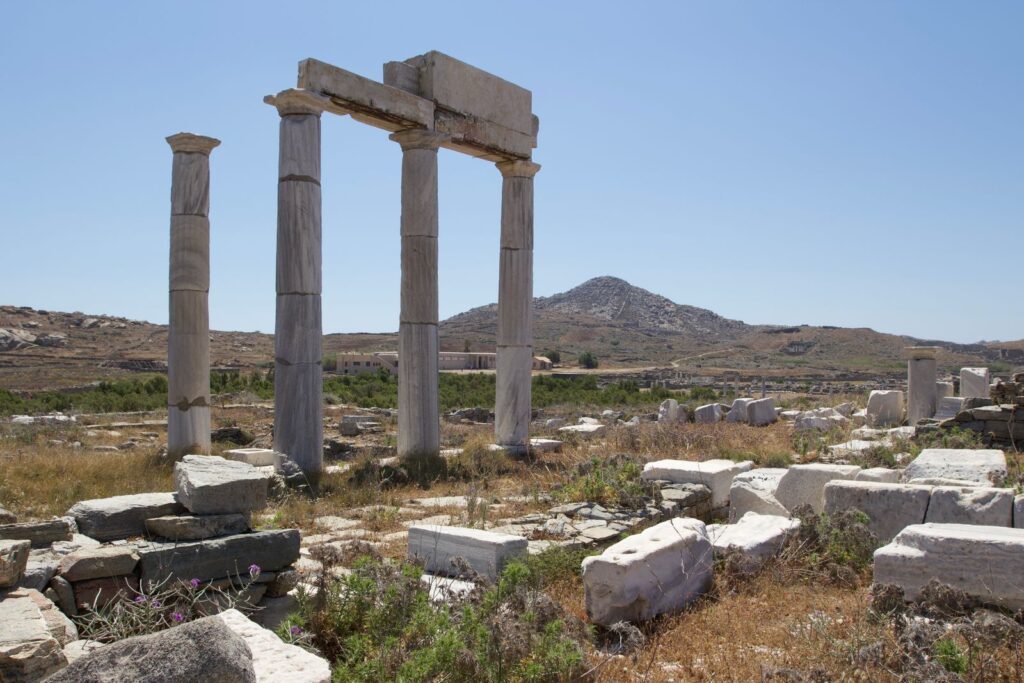
Delos is the small, uninhabited island just off the coast of Mykonos, and one of the most important archaeological sites in Greece. In mythology it is the birthplace of Apollo and Artemis; in history it was a great sanctuary and, later, one of the busiest trading ports of the ancient Mediterranean. Today it’s a UNESCO World Heritage Site you can reach by boat from Mykonos harbour in around half an hour, wander for a morning, and be back in town in time for a swim and a long dinner.
Key Takeaways
- Delos is a short boat ride from Mykonos Town and works perfectly as a half-day trip.
- The entire island is an open-air archaeological site, ruins of temples, houses, mosaics and its famous stone lions.
- There is little shade and almost no facilities: bring water, a hat and good shoes.
- Go in the morning, return by early afternoon, and reward yourself with dinner back in Chora.
Why is Delos famous?
Few places in Greece pack so much significance into so little land. In Greek mythology, Delos was the floating island where Leto gave birth to Apollo, god of light, and his twin sister Artemis. That divine birthright made it one of the most sacred places in the ancient Greek world, drawing pilgrims and offerings for centuries.
Later, Delos boomed as a free port, a cosmopolitan trading hub where merchants from across the Mediterranean built houses, temples and markets. Then history moved on and the island was abandoned, leaving what remained essentially sealed in time. That’s what makes it extraordinary today: you’re not looking at one monument but walking through an entire ancient city.
What can you see on Delos?
The site rewards slow wandering. Highlights include the Terrace of the Lions, the row of archaic marble lions that has become the island’s emblem, the remains of grand sanctuaries, an ancient theatre, and merchants’ houses with beautifully preserved floor mosaics. There is also an on-site museum housing finds from the excavations.
| Highlight | What it is | Why see it |
|---|---|---|
| Terrace of the Lions | A row of archaic marble lions | The island’s best-known image |
| Sanctuary of Apollo | The main sacred precinct of the ancient site | The religious heart of Delos |
| Ancient theatre | A stone theatre from the island’s busy period | A sense of how lively the ancient city was |
| Merchants’ houses | Homes with well-preserved floor mosaics | A glimpse of life in the ancient trading port |
Allow time to stop at the houses, where the courtyard layouts show how wealthy merchants lived. A guided tour or a good guidebook makes the ruins much easier to read, because context turns stones into stories.
For the best overview, walk up Mount Kynthos, the modest hill at the island’s centre. From the top you can see the whole sacred island laid out below and the Cyclades scattered around you. The view alone justifies the climb, especially on a clear morning.
How do you get to Delos from Mykonos?
By boat from Mykonos Town, the crossing is short, usually around thirty minutes. Boats run regularly in season from the harbour area; guided tours are also available and worth considering, because Delos is a site where context transforms what you’re seeing. Schedules vary through the year, so check departure times locally or ask your hotel to confirm the day before.
Two practical notes: Delos is a protected archaeological site, so nobody stays overnight. You visit and return the same day. The season matters too: boats are frequent in summer and sparse in the depths of winter. If you’re planning a trip around it, our guide to the best time to visit Mykonos covers how the island year works.
What should I bring to Delos?
More than you’d think for such a short hop. The island is essentially bare, sun-bleached stone, low ruins and open sky, so bring:
- Water, more than one bottle in summer.
- A hat and sunscreen, as there is almost no natural shade on the site.
- Proper shoes, since the paths are uneven, rocky and ankle-testing in sandals.
- A light layer, because the meltemi can be strong on the crossing and on Mount Kynthos.
Facilities on the island are minimal by design. Treat it like a small expedition: go prepared, and the site gives you everything.
How long should I spend on Delos?
Two to four hours suits most visitors, enough for the main sanctuaries, the lions, a house or two with mosaics and the Kynthos climb, without wilting in the sun. Archaeology lovers can happily fill longer, but the smart shape for the day is simple: morning boat out, early-afternoon boat back.
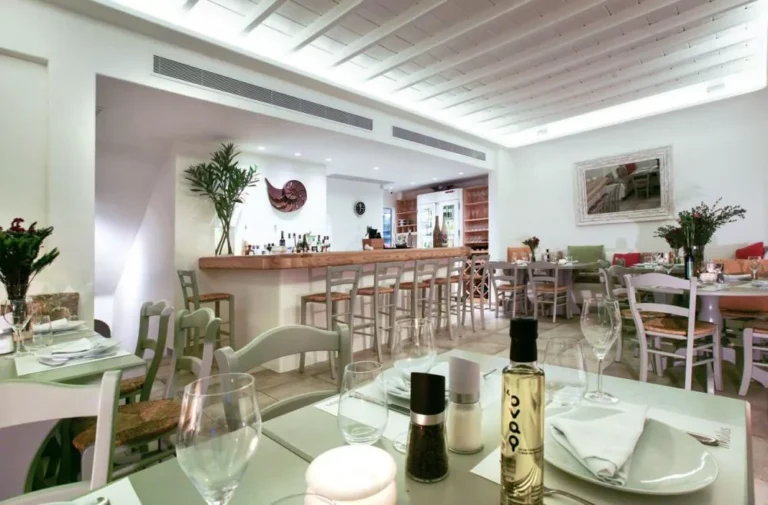
That rhythm leaves the rest of your day free, and it’s the reason Delos pairs so well with an evening in town. You’ve walked through three thousand years of history; now you’ve earned a proper dinner. Back in Chora, you can finish the day at Nautilus Mykonos, in the Lakka quarter by the old post office. Browse our Mykonos dinner guide for reservation tips, and book your table before you sail.
Is Delos worth it if I’m not “into” history?
Honestly, yes. Even if you never read a single information panel, Delos delivers: a boat ride across blue water, an entire silent city of white stone, lions standing guard over an empty harbour, and a hilltop view over the whole of the Cyclades. It’s the most atmospheric few hours you can spend near Mykonos, and a complete change of register from the island’s beach-and-bar energy.
And if you are into history, it’s simply one of the great sites of Greece. Either way, it belongs on your list of things to do in Mykonos.
For the trip to the Old Port and the rest of your island logistics, see our guide to getting around Mykonos.
Frequently Asked Questions
How to travel from Mykonos to Delos?
Take a boat from the harbour in Mykonos Town, where the crossing takes around thirty minutes. Boats run regularly in season, so check departure times locally or ask your hotel to confirm the day before. Guided tours are also available if you want more context on the site.
What to do in Delos?
Walk the archaeological site at a slow pace and see the Terrace of the Lions, the sanctuaries, the ancient theatre and the mosaics in the merchants’ houses. The climb up Mount Kynthos is worth it for the view over the whole island.
What is Delos famous for?
Delos is famous as the mythical birthplace of Apollo and Artemis, and as one of the most important archaeological sites in Greece. It was a great sanctuary and later a busy trading port, and today it is a UNESCO World Heritage Site.
How much is the entrance fee to Delos?
There is an entrance fee to the archaeological site on Delos. Prices can change, so check the current ticket cost locally before you sail.
Where is the ferry terminal in Mykonos?
The boats to Delos leave from the harbour in Mykonos Town, so that is the place to head for the trip. The island’s ports are not all in the same spot, so confirm the departure point with your boat operator or hotel before you go.
Can you stay on Delos island?
No. Delos is a protected archaeological site with no hotels, so nobody stays overnight and every visit is a day trip. The usual plan is a morning boat out and an early afternoon boat back.
How long does it take to walk around Delos ruins?
Most visitors spend two to four hours on the island, which is enough for the main sanctuaries, the Terrace of the Lions and a few merchants’ houses with mosaics. Allow extra time if you want to climb Mount Kynthos for the view over the Cyclades.