Greek desserts are built on a handful of honest ingredients, nuts, honey, phyllo, semolina and yogurt, layered and syruped into something far greater than their parts. Unlike heavy, cream-based desserts common elsewhere, most Greek sweets lean on syrup, spice and texture rather than sugar alone. Here’s a guide to the classics you’ll meet on menus across the country, and the island versions that turn up in Mykonos.
Key Takeaways
- Greek desserts are mostly syrup-soaked, not cream-based: baklava, galaktoboureko and loukoumades all get their sweetness from a honey or sugar syrup poured on after baking or frying.
- Phyllo pastry, semolina custard and ground nuts (walnuts, almonds, pistachios) are the building blocks behind most classic sweets.
- Spoon sweets (glyka tou koutaliou) are fruit preserved whole in syrup, traditionally offered to guests as a gesture of hospitality.
- Almond sweets such as amygdalota turn up in island bakeries, Mykonos included, alongside the mainland classics.
- Greek yogurt with honey is the simplest, and arguably most authentic, Greek dessert of all.
What are the most famous Greek desserts?
A handful of names come up again and again, and each represents a different technique within the same sweet tradition.
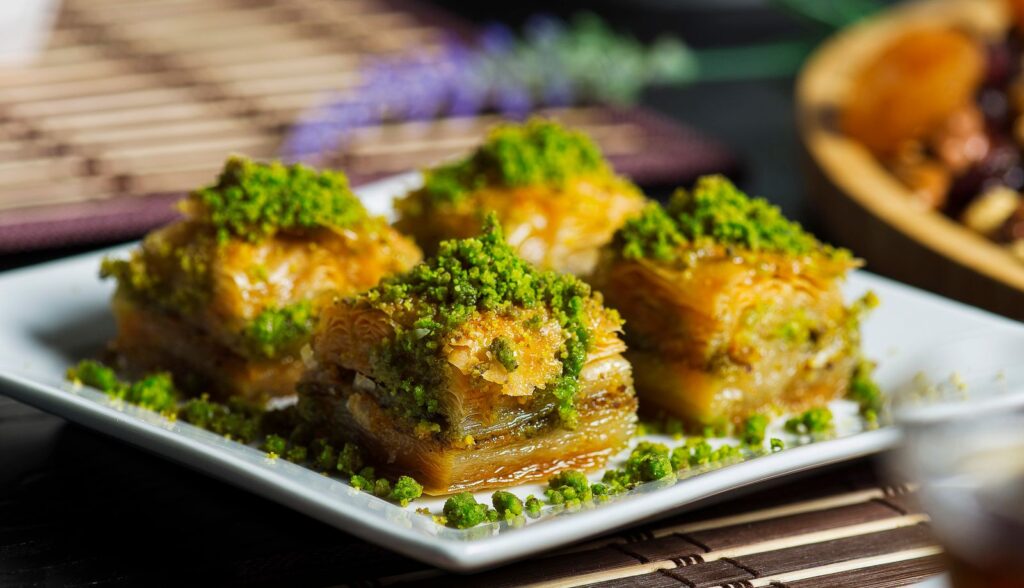
Baklava is the best known internationally: layers of crisp phyllo pastry, chopped walnuts (sometimes with almonds or pistachios), warmed with cinnamon and clove, baked until golden and then soaked in a honey or sugar syrup. The layering is what gives it structure, thin sheet after thin sheet, so that every bite carries both crunch and syrup.
Galaktoboureko takes a different route: a silky semolina custard baked between sheets of phyllo, then drenched in syrup once it comes out of the oven. It’s lighter than it sounds, the custard is more delicate than dense, and the contrast between the crisp top layer and the soft filling is the whole point.
Kataifi uses the same nut-and-syrup logic as baklava, but wraps it in shredded phyllo strands instead of flat sheets, giving it a texture closer to a nest or a shredded-wheat pastry once it’s baked and syruped.
Greek desserts at a glance
| Dessert | Main base | Texture |
|---|---|---|
| Baklava | Phyllo, chopped nuts, honey syrup | Crisp layers, sticky with syrup |
| Galaktoboureko | Phyllo, semolina custard, syrup | Crisp top, soft custard inside |
| Loukoumades | Fried dough balls, honey, cinnamon | Crisp outside, soft inside |
| Semolina halva | Semolina, butter, sugar syrup | Dense and sliceable |
| Amygdalota | Ground almonds, sugar, rosewater | Delicate and fragrant |
What is loukoumades, and why is it different?
Loukoumades are small, deep-fried dough balls, similar in spirit to doughnut holes, soaked in honey syrup and usually finished with a dusting of cinnamon and a scatter of chopped walnuts. They’re served warm, which matters: the syrup soaks in while the dough is still hot, and the outside stays lightly crisp while the inside turns pillowy.
They’re considered one of Greece’s oldest desserts, associated for centuries with celebration and hospitality, and they remain one of the few Greek sweets commonly eaten warm, straight from the fryer, rather than at room temperature.
What is halva, and how many kinds are there?
Halva is less a single dessert than a family of them. The two most common versions in Greece are quite different from each other. Semolina halva (often called halvas simigdaliou) is made by toasting semolina in butter or oil, then cooking it with a sugar syrup and spices like cinnamon, until it sets into a dense, sliceable cake, often studded with almonds or walnuts. Tahini halva, by contrast, is made from sesame paste and sugar, pressed into a firm, crumbly block, sometimes marbled with chocolate or studded with pistachios. It needs no baking at all, and its nutty, slightly bitter edge sets it apart from the honey-forward sweetness of most other Greek desserts.
What is ravani?
Ravani is a semolina and yogurt sponge cake, baked until golden and then soaked in a light syrup, sometimes scented with orange or lemon. It’s simpler and moister than a Western sponge cake, closer in spirit to galaktoboureko than to a Western-style birthday cake, and it’s a staple at Greek bakeries and home tables alike, often served in neat squares.
What are spoon sweets, and why are they served that way?
Glyka tou koutaliou, literally “spoon sweets,” are whole or large pieces of fruit, cherries, quince, bitter orange, small green walnuts, figs, preserved slowly in a thick sugar syrup until they turn glossy and intensely flavoured. The name comes from how they’re traditionally served: a single spoonful, offered on a small dish alongside a glass of cold water, as a welcome to guests in a home. It’s less a dessert course in the Western sense and more a gesture, a small, sweet greeting rather than something eaten in quantity. You will still find the custom across Greece, including on the islands, where spoon sweets made from local fruit are a familiar sight.
What sweets are linked to Mykonos and the Cyclades?
Island bakeries add their own touches to the Greek dessert table. One common example is amygdalota, small almond cookies or dumplings made from ground almonds, sugar and a touch of rosewater or orange blossom water, often shaped by hand and dusted with icing sugar. They are a regular sight in island patisseries, and their delicate almond flavour pairs easily with a cup of coffee.
Honey, and thyme honey in particular, runs through many island desserts, drizzled over yogurt or pastries. It is a reminder that, as everywhere in Greece, the best dessert is often the simplest one.
Is Greek yogurt with honey really a dessert?
Yes, and for many Greeks it’s the everyday one. Thick, strained Greek yogurt topped with a generous spoonful of honey, sometimes with walnuts scattered on top, is a staple dessert found on tables and menus across the country. It’s the clearest expression of what makes Greek sweets distinctive: a handful of excellent ingredients, allowed to speak for themselves rather than buried under sugar. It’s also the easiest way to end a meal without straying far from the savoury, honey-and-herb character that runs through so much Greek cuisine.
Where to try these desserts in Mykonos
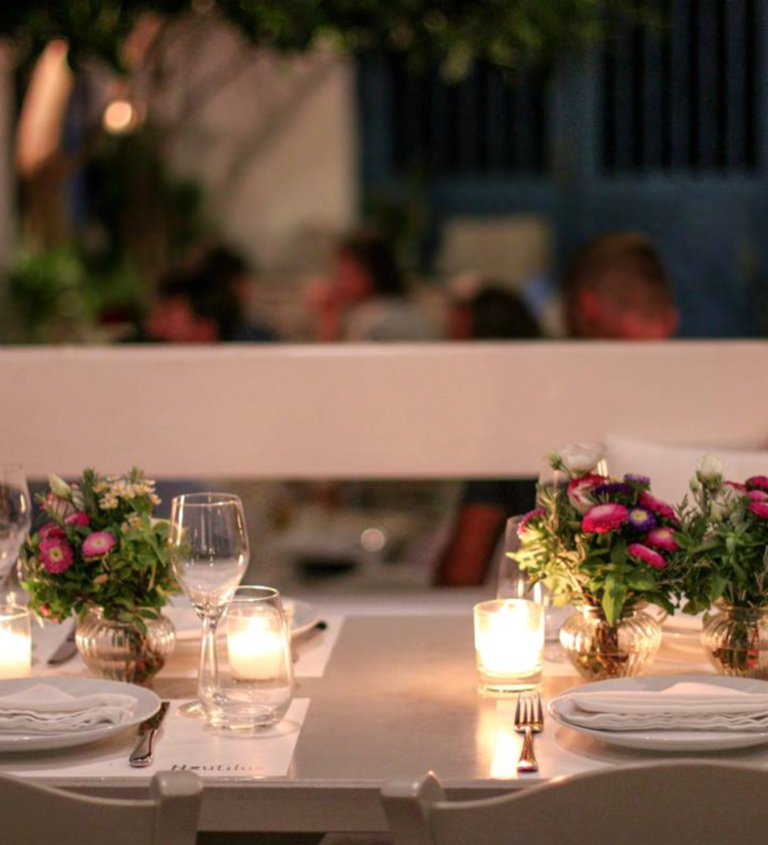
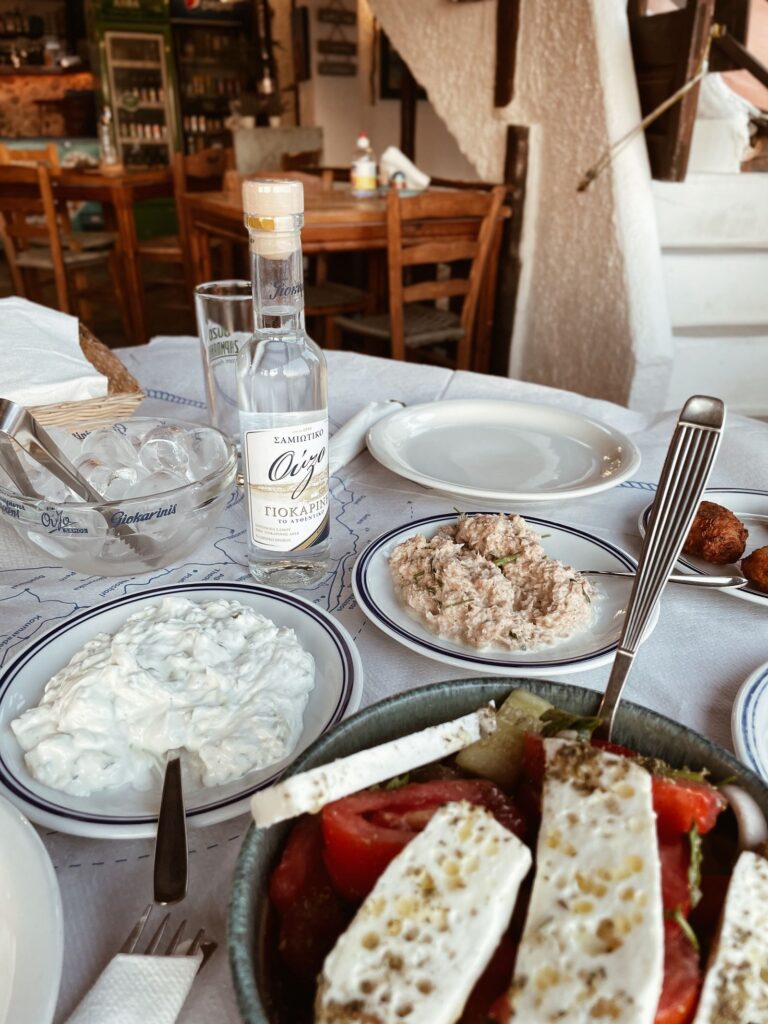
Bakeries and tavernas in Mykonos Town serve many of these classics, and a proper Greek meal on the island, much like the meze table that precedes it, is often built to end this way: something small, sweet and unhurried. At Nautilus, we serve Greek and Mediterranean cuisine, with seafood, fresh fish, meat and pasta. If you would like to eat with us, reserve a table.
For where to try sweets on the island itself, read our guide to desserts in Mykonos.
Frequently Asked Questions
What did the Greeks eat for dessert?
Many everyday meals ended with fruit, yogurt with honey or a spoon sweet, rather than a heavy cake. Syrup pastries and fried dough such as loukoumades were more often saved for celebrations and special occasions.
What are the 9 common desserts?
A common list of nine is baklava, galaktoboureko, kataifi, loukoumades, semolina halva, ravani, amygdalota, spoon sweets and yogurt with honey. Each one is covered in the sections above, and tahini halva is a close relative of the semolina version.
What are the five most popular desserts?
Five names come up most often in lists of Greek sweets: baklava, galaktoboureko, loukoumades, kataifi and halva. Together they cover crisp phyllo, creamy custard, fried dough and nut-filled pastry, which gives a good picture of the whole tradition.
What is the most famous food in Greece?
There is no official answer, but moussaka, souvlaki and Greek salad are among the best known Greek dishes abroad. For sweets, baklava is the most widely recognised Greek dessert outside the country.
What are some famous Greek meals?
Classic examples include moussaka, pastitsio, souvlaki and a shared meze table. Many meals end with something simple, such as fruit or yogurt with honey, and a sweet from this guide when the table wants one.
What is Greek baklava made of?
Greek baklava is made of thin layers of crisp phyllo pastry, filled with chopped nuts, usually walnuts, and flavored with cinnamon and clove. It is baked until golden, then soaked in a honey or sugar syrup.
Is baklava healthy or unhealthy?
Baklava is best treated as an occasional treat, since it is high in sugar and butter. The nuts add some healthy fats, but the honey or sugar syrup adds a lot of sugar.